2026 Notary Law Changes: New Rules
Founder

2026 Notary Law Changes: New Rules You Need to Know
Every year, dozens of state legislatures amend their notary statutes. Fee caps are raised. New notarial acts are authorized. Remote online notarization frameworks are expanded, tightened, or launched for the first time. Journal mandates are added. Seal specifications are updated.
Most notaries only find out about these changes when something goes wrong — a title company rejects a document, a client questions a fee, or a compliance review flags an outdated procedure.
This roundup covers the most significant notary law changes taking effect in 2026. If you hold a commission in any of the states listed below, review these changes carefully and update your procedures accordingly.
Why 2026 Is a Significant Year for Notaries
Several converging trends are reshaping notary law in 2026 more sharply than in recent years.
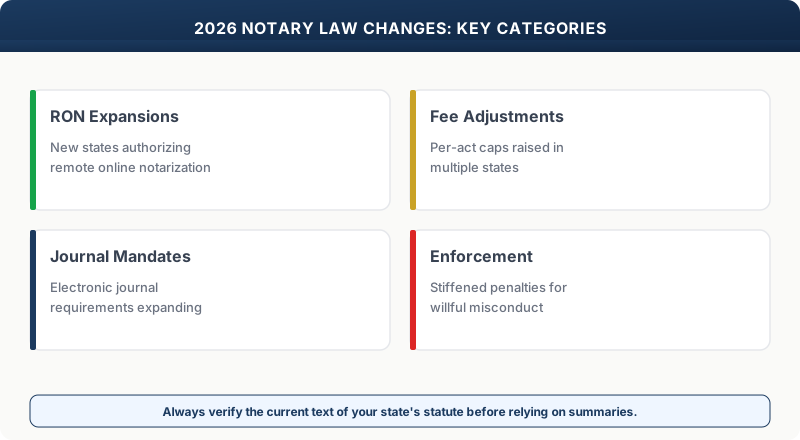
The post-pandemic RON normalization. Remote online notarization was authorized in many states during or immediately after COVID-19 as emergency or temporary legislation. A substantial number of those temporary authorizations have since been converted into permanent law — and states that sat on the sidelines are now passing RON legislation for the first time. 2026 brings both new RON entrants and meaningful updates to existing frameworks.
Fee cap inflation adjustments. Notary fee caps in many states had not been meaningfully revised in a decade or more. In 2025 and 2026, a wave of states passed legislation to bring fee caps in line with current economic realities. For notaries practicing in affected states, these changes directly affect what you can lawfully charge.
Electronic journal mandates. As electronic and remote notarization practices have matured, state regulators have updated journal requirements to address how digital records are created, stored, and audited. Several states are now mandating electronic journals for notaries who perform electronic or remote notarizations, while others are revising paper journal requirements.
Increased enforcement activity. Regulators in California, Florida, and Texas have signaled increased enforcement attention on notarial misconduct — particularly unauthorized practice of law, improper identification procedures, and fee gouging. Several states have also stiffened penalties for willful notarial misconduct.
Remote Online Notarization (RON) Expansions
New States Authorizing RON
As of early 2026, the following states have enacted RON legislation that was not yet in effect as of the start of 2025:
Mississippi passed RON legislation that took effect January 1, 2026. The Mississippi RON framework follows the RULONA model and requires notaries to use a state-approved platform, complete a supplemental RON application with the Secretary of State's office, and maintain an electronic journal and audio-video recording of each RON session for a minimum of five years.
South Carolina enacted permanent RON authorization in late 2025 after operating under a temporary emergency framework since 2020. South Carolina's permanent rules require identity proofing via knowledge-based authentication (KBA) and credential analysis, platform approval by the Secretary of State, and an electronic journal. Notaries who performed RON under the emergency authorization must re-register under the permanent rules.
Arkansas authorized RON effective March 1, 2026. The Arkansas framework is technology-neutral — the state does not pre-approve platforms — but requires notaries to ensure any platform used meets specified minimum security and record-keeping standards.
Significant Updates to Existing RON Frameworks
Virginia updated its RON regulations to expand the list of approved technology providers and clarify requirements around multi-signatory transactions. Virginia also clarified that a Virginia RON notary may notarize documents for signers located in foreign countries, provided the document will be used in a U.S. jurisdiction.
Florida amended its RON statutes to address several ambiguities that had created friction with title insurance underwriters. The updates clarify chain-of-custody requirements for electronically notarized documents, specify minimum resolution requirements for audio-video sessions, and formalize the process for handling a signer who fails identity verification mid-session.
Texas updated its RON rules to require that the audio-video recording of each RON session be stored for a minimum of seven years (up from five), aligning Texas with the federal standard for mortgage-related records under RESPA.
States Still Without RON Authorization
As of April 2026, the following states have not yet authorized RON: Georgia, Louisiana, New Mexico, North Dakota, and Wyoming. Notaries in these states cannot lawfully perform RON regardless of what platform they use or where the signer is located. Legislative activity is pending in Georgia and Louisiana; both states are expected to pass RON legislation before the end of 2026.
For the comprehensive state-by-state RON reference (eligibility, technology requirements, identity-proofing standards), see Remote Online Notarization: State-by-State Guide.
Notary Fee Increases
A number of states updated their maximum notary fee schedules in 2025–2026. The table below summarizes the changes.
California's increase is the most significant. California notaries can now charge up to $20 per notarial act (acknowledgment, jurat, or other act), up from $15. The increase applies to in-person notarizations; California's RON fee cap remains separate and is set by regulation. California has not adjusted its per-signature fee since 2017.
New Jersey's long-overdue revision. New Jersey's previous $2.50 cap — one of the lowest in the country — had not been updated since 1979. The new $5 cap still ranks among the lowest nationally but represents a meaningful adjustment.
Important: These caps represent maximums — you may charge less. Several states also permit separate travel fees or document preparation fees in addition to per-signature fees. Always review your state's full fee schedule, not just the per-act cap.
New and Updated Journal Requirements
States Adding Journal Mandates
Minnesota now requires all notaries to maintain a sequential notarial record (journal) for every notarization performed. Previously, Minnesota had no journal requirement. The new requirement took effect January 1, 2026, and applies to both in-person and remote notarizations. Each entry must include the date and time, type of notarial act, name of each signer, description of the document, and the identification method used.
South Carolina added a journal requirement as part of its permanent RON legislation, applicable to all RON sessions. Paper notarizations are not subject to the new journal requirement, though the Secretary of State recommends maintaining records for all notarizations regardless.
Updates to Existing Journal Requirements
California clarified that sequential journal entry numbering is mandatory. Entries may not be backdated, and correction of an erroneous entry must be made by a separate corrective entry — not by crossing out or altering the original. The California Secretary of State's office also reiterated that journals must be surrendered to law enforcement upon a valid subpoena or court order, and that a notary who willfully refuses to produce a journal faces suspension or revocation of their commission.
Florida updated its journal rules to specify retention periods for electronic RON journals. Electronic journals and audio-video recordings must be maintained for a minimum of ten years following the date of notarization. Third-party platform providers may retain records on behalf of notaries, but the notary remains legally responsible for ensuring the records are accessible.
Nevada now requires that journal entries for identity verification include the specific document examined (e.g., "California DL, #X1234567, exp 01/2030") rather than simply noting that ID was checked. This level of specificity has been recommended practice for years; Nevada has now codified it.
Seal and Stamp Specification Changes
Updated Seal Requirements
Oregon updated its notary seal specifications effective January 1, 2026. The updated rules require the notary's commission expiration date to appear on the seal. Previously, Oregon seals required the notary's name, the words "Notary Public," and "State of Oregon," but expiration date was optional. Oregon notaries who obtained their current seal before January 1, 2026, may continue using that seal for the remainder of their current commission term, provided the seal otherwise conforms to requirements.
Colorado revised its seal specifications to require a minimum font size for printed elements, addressing complaints from title companies and county recorders about illegible seals on scanned documents. The minimum legibility standard requires that all text on the seal be readable at 300 DPI when scanned — a practical rather than prescriptive standard, but one that effectively requires many notaries to upgrade to higher-quality stamps.
Electronic Seal and Signature Standards
Multiple states — including Virginia, Minnesota, and Iowa — updated their standards for electronic notary seals and digital signatures used in electronic notarizations. The common thread across these updates is alignment with current NIST (National Institute of Standards and Technology) digital identity standards and deprecation of certain older signature algorithms. If you perform electronic notarizations using platform-issued digital credentials, your platform should update automatically; however, it is worth confirming with your platform provider that their technology meets the updated state standards.
Other Notable Changes
Texas — Prohibited Acts Clarification. Texas amended its notary statutes to clarify the prohibition on unauthorized practice of law. The amendment specifically addresses the use of artificial intelligence tools by notaries: a Texas notary may not use an AI-generated document template as a substitute for legal advice, and may not represent to a signer that an AI-generated form is legally sufficient for their particular situation. This clarification follows enforcement actions in 2024 and 2025 against notaries who were marketing AI-assisted document preparation services.
California — Background Check Renewal. Starting with commissions renewed or newly issued after January 1, 2026, California is conducting a new background check at each renewal — not just at initial commissioning. Previously, a background check was required only for first-time applicants. This change was driven by regulatory concerns about notaries with post-commission criminal convictions continuing to practice.
Illinois — Electronic Notarization Platform Approvals. Illinois published its first list of approved RON technology providers and announced that as of July 1, 2026, Illinois notaries may only perform RON using a platform on the approved list. Previously, Illinois RON rules were platform-neutral. Notaries currently performing RON in Illinois should verify that their current platform is on the approved list before the July 1 effective date.
Pennsylvania — Loan Signing Agent Disclosure. Pennsylvania now requires notaries who act as loan signing agents to provide a written disclosure to signers explaining that the notary is not an attorney and cannot provide legal advice. The disclosure must be provided before the signing begins and retained with the notary's records.
How to Stay Current Automatically
The single most reliable way to stay current on notary law changes is to build a system — not to rely on memory or occasional research.
Bookmark your state's official notary page. Every Secretary of State's office maintains a notary section with current statutes, regulations, and fee schedules. Visit it at least quarterly.
Subscribe to your state notary association's communications. Most state notary associations send legislative alerts when bills affecting notaries are introduced, passed, or signed into law.
Use Notary Guide. Our platform tracks state notary statutes across all 50 states and sends you alerts when laws in your commissioned state change. You don't need to monitor anything manually — when a change goes into effect that affects your practice, we notify you directly with plain-language explanations and updated step-by-step guidance.
The cost of missing a law change is real: a rejected document means a return trip for the signer, a fee dispute, or — in serious cases — a complaint filed with your Secretary of State. Staying current is the most basic form of professional protection available to you.