Why Notary Compliance Tools Matter
Founder
Why Notary Compliance Tools Matter: The Cost of Getting It Wrong
Every notarization you perform carries legal weight. A signed and sealed document travels through title companies, courts, financial institutions, and government agencies — each assuming the notarization was performed correctly. When it wasn't, the consequences move fast and they move hard.
Most notaries operate in good faith. The errors that end commissions and invite lawsuits aren't usually caused by negligence — they're caused by outdated information, ambiguous statutes, and the practical impossibility of memorizing every procedural requirement across every situation you'll encounter in the field. The notary who got it wrong usually thought they were getting it right.
That's the core problem that notary compliance tools exist to solve. This article breaks down what's actually at stake when a notarization goes wrong, where the most common mistakes happen, and why purpose-built compliance tools are fundamentally different from the patchwork of Googling and handbooks most notaries currently rely on.
What Happens When a Notarization Goes Wrong
The consequences of a flawed notarization aren't hypothetical. Regulators, courts, and lenders all have mechanisms to respond — and they use them.
Commission Revocation
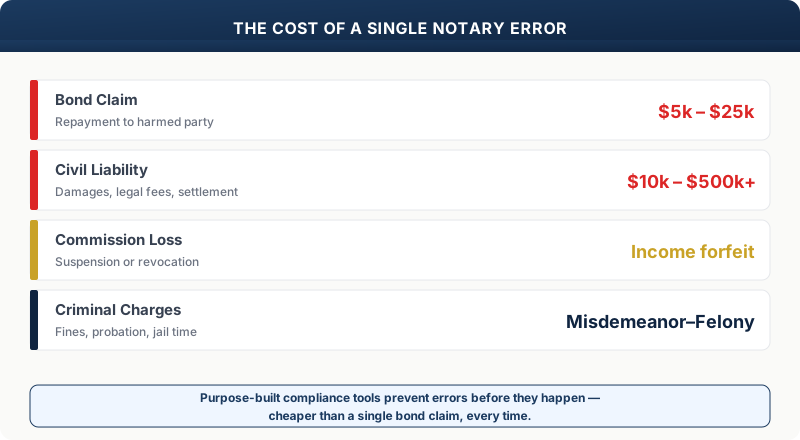
Your notary commission is issued by the state. The state can take it back. Grounds for revocation vary, but most states include willful misconduct, official misconduct, fraud, and — critically — negligence. A single documented error, particularly one that results in a complaint to the state's notary regulatory office, can trigger an investigation. Investigations become hearings. Hearings become revocations.
Revocation doesn't just end your notary practice. It goes on record. Future commission applications in other states may require you to disclose prior disciplinary actions. A revoked commission can follow you.
Surety Bond Claims
Most states require notaries to carry a surety bond — typically between $5,000 and $15,000, sometimes more. The bond exists to protect the public, not you. If a third party suffers damages because of your error, they can file a claim against your bond. The surety pays out, then seeks reimbursement from you.
Bond claims don't require a finding of fraud. Negligence — performing a notarization in a way that deviates from required procedure — is sufficient. The bar for a claim is lower than most notaries realize.
Civil Liability
Even with a bond, you can be sued directly. Civil liability follows when a party demonstrates that your error caused them measurable harm. In real estate transactions, where closings can involve hundreds of thousands of dollars, "measurable harm" can be substantial. A defective acknowledgment that invalidates a deed of trust. A jurat performed without the required oath. A document notarized without proper identification of the signer.
Errors and Omissions (E&O) insurance is designed to cover this exposure, but policies have limits and exclusions — and not every notary carries it.
Criminal Penalties
This is the category most notaries never expect to face, and yet it exists. Knowingly performing a fraudulent notarization can constitute a crime — ranging from a misdemeanor to a felony depending on the state and the nature of the fraud. Even errors that begin as civil matters can escalate if regulators conclude the notary acted with reckless disregard for procedure.
The phrase "I didn't know I was doing it wrong" is not a legal defense. The law presumes you know the requirements of your commission.
The Most Common Notary Errors
Understanding where things go wrong is the first step to preventing it. These are the errors that generate the most complaints, bond claims, and regulatory actions against notaries.
Wrong Certificate Wording
Acknowledgment and jurat certificates have specific required language — and that language varies by state. Using an out-of-state certificate form, an outdated template pulled from the internet, or a form that doesn't match the notarial act being performed can invalidate the entire notarization.
This is more common than it sounds. Signers sometimes show up with pre-printed certificates that come from another jurisdiction. Title companies occasionally send packets with forms that weren't designed for the state where the signing is taking place. The notary is the last line of defense — and often the person held responsible.
Failing to Administer the Oath for Jurats
A jurat requires that the signer swear or affirm that the contents of the document are true. That oath must be administered — out loud, in the notary's presence — before the notary signs and seals. Skipping it, assuming it's just a formality, or allowing a signer to simply sign without the verbal oath turns the jurat into a defective notarization.
This is one of the most frequently cited errors in notary complaints. The oath isn't a suggestion. It's a legal requirement.
Improper Identification Verification
Every state has rules about what forms of ID a notary may accept to establish signer identity. Expired documents, foreign documents, or document types not enumerated in state statute may not qualify. Accepting an unacceptable ID — or failing to document the ID properly in your journal — creates exposure.
Some states also have credible witness provisions and personal knowledge exceptions. Applying the wrong standard to a given situation is itself an error.
Notarizing for Family Members
Many states prohibit notarizing for immediate family members. Others prohibit notarizing for any person in whom you have a financial interest. The definitions vary — "immediate family" means different things in different statutes — and the prohibition is easy to overlook when a spouse or parent asks for a quick notarization.
This is a trap that catches notaries who've been doing the job for years. Familiarity breeds assumptions about what's allowed.
Missing or Incomplete Journal Entries
Most states require notaries to maintain a journal of every notarial act. The required fields vary — date, type of act, document description, signer name, ID type and number, signature, fee — but omitting required fields is itself a violation. In states with strict journal requirements, an incomplete entry can be grounds for disciplinary action independent of whether anything else went wrong with the notarization.
In the event of a fraud investigation, your journal is your primary defense. A journal that's incomplete or inconsistent with the documents you notarized creates problems even when you acted in good faith.
For the enumerated list of the top errors with exact avoidance steps per mistake, see 10 Common Notary Mistakes and How to Avoid Them.
How Most Notaries Currently Handle Compliance
Most notaries piece together their compliance knowledge from a combination of sources — and the picture is less reliable than it appears.
State-issued handbooks are the starting point. Every state provides some form of notary handbook or statute compilation when you're commissioned. These are authoritative, but they're static. A handbook printed at the time of your commission doesn't reflect legislative changes enacted the following session. Statutes change. Case law evolves. Remote Online Notarization laws are still being written across multiple states.
Employer training is another common source, particularly for notaries embedded in financial institutions, title companies, or law firms. Institutional training is often good — but it's calibrated to the employer's standard transactions. The notary doing mobile signing encounters situations the institutional training didn't anticipate.
Googling is where most notaries end up when they face an unfamiliar situation in the field. A statute search, a forum post, a state association FAQ — assembled in real time, under time pressure, while a signer is sitting across the table. This is the highest-risk approach to compliance. Search results go stale. Forum posts reflect individual interpretations. Unofficial sources have no accountability for accuracy.
Memory is what most experienced notaries fall back on. Pattern recognition built over years of practice. This works — until it doesn't. State law changes without notice. An edge case appears that the usual pattern doesn't cover. Memory doesn't update automatically when the statute does.
The fundamental problem with all of these approaches is that they're asynchronous with the actual requirements. You're working with information that may be accurate, may be current, and may apply to your specific situation — but you have no reliable way to verify any of those things at the moment you need to.
What Purpose-Built Compliance Tools Do Differently
A purpose-built notary compliance tool isn't a search engine and it isn't a handbook. It's a system designed specifically for the problem of keeping notaries current and accurate across a wide range of situations.
State-specific guidance, not generic rules. Compliance tools are built around jurisdiction-specific requirements. When you're performing a notarization in California, you see California's rules — not a national average or a "most states require" approximation. When you cross the state line into Nevada, the tool reflects Nevada's requirements. The specificity is the point.
Always current. Statutory changes, regulatory updates, and new Remote Online Notarization frameworks get incorporated into the tool. You don't have to track the legislative calendar in every state where you're commissioned. The tool does it for you.
Available offline. Mobile notaries work in places without reliable internet access. A compliance tool that requires a live connection fails exactly when you need it most. Purpose-built tools designed for field use are available offline — the guidance you need is there whether you're in a hospital room, a correctional facility, or a rural property with no signal.
Step-by-step procedural checklists. Rules are one thing. Procedure is another. A compliance tool walks you through the steps of each notarial act — in order, with nothing assumed. Administer the oath before the signature. Confirm identity before completing the certificate. Review the document for completeness before applying the seal. The checklist doesn't let you skip steps.
Searchable by situation. Field conditions are unpredictable. A compliance tool lets you find guidance by situation — "signer cannot sign," "document has no notarial certificate," "signer refuses to remove face covering" — not just by statute citation. The tool is designed around what actually happens during signings.
Notary Guide Newsletter
Stay current on notary law changes, compliance guidance, and tools that make your practice more efficient.
Subscribe at notaryguide.app — free, no spam.
The ROI of Getting It Right
The practical case for notary compliance tools comes down to simple math.
A notary signing agent earning $75–$150 per signing who loses their commission loses their income stream entirely — not just for one signing but for every signing they would have performed. If that notary does 10 signings a month at $100 average, that's $12,000 in annual income tied directly to maintaining a valid commission.
One avoided error — one bond claim not filed, one regulatory complaint that never materializes, one civil suit that never gets initiated — pays for years of a compliance tool subscription.
The calculus is even clearer for experienced notaries and signing agents who've built a book of business with title companies and signing services. Those relationships took years to build. They can be destroyed in a single transaction. When a signing service gets a complaint about a notarization, they don't just stop sending that notary assignments — they document it, and that documentation follows the notary's reputation through the industry.
Professional reputation in the notary industry is a direct economic asset. Title companies vet the notaries they assign to closings. Signing services have rating and feedback systems. Errors become visible to the people who control your assignment flow.
Compliance tools protect that reputation proactively, before an error has a chance to happen.
The notaries who earn the most over a long career aren't necessarily the fastest or the most available. They're the ones who build a reputation for getting it right, consistently, over thousands of notarizations. That reputation is built one careful, procedurally correct notarization at a time — and maintained by staying current with the law.
Built for Notaries Who Can't Afford to Get It Wrong
Notary Guide is a compliance tool built specifically for working notaries. It covers all 50 states with current, jurisdiction-specific guidance — accessible offline, organized by task, and designed for use in the field during an actual signing.
We're in beta now, accepting a limited number of notaries who want to be among the first to use the platform and help shape what it becomes.
If your livelihood depends on doing this right, Notary Guide was built for you.
Join the beta at notaryguide.app.