California Notary Requirements 2026
Founder

California Notary Requirements: The Complete 2026 Guide
California operates one of the most regulated notary programs in the country. The state mandates a proctored exam, a mandatory sequential journal, thumbprint collection for real property documents, and one of the strictest fee schedules in the nation. Whether you are applying for your first commission or renewing after four years, this guide covers every requirement you need to stay compliant.
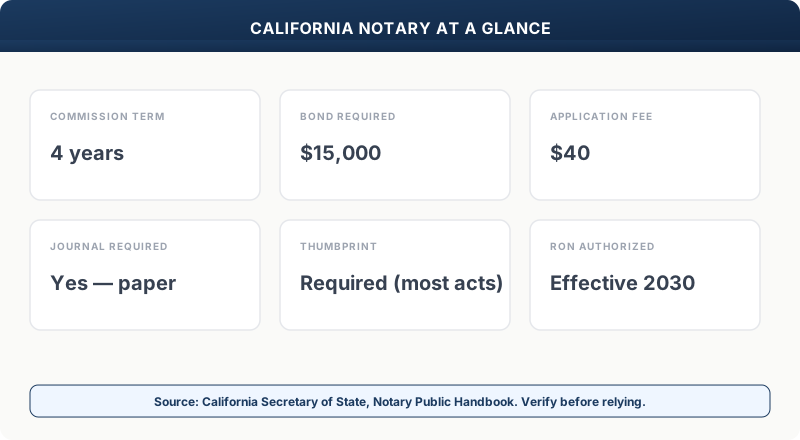
California Notary at a Glance
How to Become a California Notary Public
Eligibility Requirements
To qualify for a California notary commission, you must:
- Be at least 18 years of age
- Be a legal California resident
- Not have been convicted of a felony (or certain misdemeanors involving dishonesty, fraud, or moral turpitude)
- Be able to read and write English
California does not require you to be a U.S. citizen. Legal permanent residents and other lawfully present non-citizens may apply.
Step 1 — Complete a 6-Hour Approved Education Course
First-time applicants must complete a six-hour notary public education course from a vendor approved by the Secretary of State. The course covers California notary law, journal requirements, seal usage, acceptable identification, notarial certificates, and prohibited acts. Renewal applicants (those currently commissioned) must complete a three-hour refresher course instead.
Courses are available in-person and online. Keep your certificate of completion — you will need it when you submit your application.
Step 2 — Pass the State Exam
California requires all applicants to pass a proctored written examination administered by an approved testing vendor. The exam consists of multiple-choice questions drawn from California notary law. The passing score is 70 percent. There is no limit on the number of retake attempts, but each sitting requires a fee.
Testing locations are available statewide. Scheduling is handled through the exam vendor (currently National Western Life Group under contract with the Secretary of State). Bring a valid government-issued photo ID on exam day.
Step 3 — Submit Your Application
After passing the exam, submit your notary public application to the California Secretary of State along with:
- Completed application form (available at sos.ca.gov)
- Proof of completed education course
- Proof of exam passage
- Filing fee (currently $40)
- Live-scan fingerprint submission (background check through DOJ and FBI)
The background check is mandatory and conducted through the California Department of Justice. Processing times vary — the Secretary of State typically issues a commission within two to three weeks after the background check clears.
Step 4 — File Your Oath and Bond
Within 30 days of your commission start date, you must:
- Obtain a $15,000 surety bond from an approved bonding company licensed in California.
- File your oath of office and bond with the county clerk in the county where you maintain your principal place of business.
If you fail to file your oath and bond within 30 days, your commission is void and you must reapply from the beginning. This is the most common reason new commissions lapse — do not wait.
After filing, you may purchase your notary seal and begin performing notarial acts.
California Notary Journal Requirements
California law requires every notary to maintain a sequential, bound paper journal. This is not optional. A spiral-bound or loose-leaf notebook does not comply — the journal must be a permanently bound book with numbered pages.
Required Journal Entries
For every notarial act, you must record:
- Date and time of the notarization
- Type of notarial act performed (acknowledgment, jurat, etc.)
- Type, title, or description of the document
- Printed name and signature of each signer
- Address of each signer
- Type of identification presented (and ID number, issuing agency, expiration date, or a description of the identifying credential)
- Fee charged, if any
- If the signer is known personally, a statement to that effect
Thumbprint Requirement for Deed-Related Documents
California has a unique and important requirement: notaries must obtain a right thumbprint (or an inked finger or toe impression if the signer is unable to provide a thumbprint) in the journal for notarizations involving:
- Deeds
- Quitclaim deeds
- Deeds of trust
- Other documents affecting real property title
This thumbprint requirement is mandatory, not discretionary. If a signer refuses to provide a thumbprint for a qualifying document, you must refuse the notarization.
Journal Retention
You must retain each completed journal for 10 years from the date of the last entry in that journal. This period runs from the last entry — not from when the journal was opened.
Do not destroy old journals. If you are audited or named in litigation, your journal is primary evidence.
Lost or Stolen Journal Protocol
If your journal is lost, stolen, or destroyed, you must notify the Secretary of State in writing within 10 days of discovering the loss. Include:
- Your name and commission number
- The approximate date range covered by the lost journal
- The circumstances of the loss
Failure to report a lost journal is itself a violation and can result in suspension or revocation of your commission.
California Notary Seal Requirements
California prohibits embosser-only seals. You must use an ink stamp — either a traditional rubber stamp or a self-inking stamp that produces a legible impression.
Required Seal Elements
Your official notary seal must contain, in a legible format:
- Your name as it appears on your commission
- The words "Notary Public"
- The name of the county in which you are commissioned
- Your commission number
- Your commission expiration date
- The State Seal of California (or the words "State of California")
The seal impression must be photographically reproducible. Use dark ink (black or blue-black) and ensure the impression is clear and complete on every document you notarize.
Lost or Damaged Seal Protocol
If your seal is lost, stolen, or damaged so that it cannot produce a legible impression, you must:
- Stop performing notarial acts immediately.
- Notify the Secretary of State in writing within 10 days if stolen.
- Order a replacement seal from a vendor.
You may not use a damaged seal that produces an illegible impression. Keep your old seal when you renew — destroy it securely (cut it up or render it unusable) to prevent unauthorized use.
California Notary Fee Schedule
Maximum Fee: $15 Per Notarial Act
As of 2024, the maximum fee a California notary may charge is $15 per notarial act per signature. Each signature on a document counts as a separate notarial act for fee purposes — if three people sign a deed and all three need acknowledgments, you may charge up to $45.
"Per notarial act" means per completed certificate. If you notarize two separate documents for the same signer in a single appointment, you may charge for each document separately.
What You Can Charge For
- Each acknowledgment: $15 maximum
- Each jurat: $15 maximum
- Each certification of a copy: $15 maximum
- Oaths and affirmations (without a signature): $15 maximum
Travel Fees
California law does not regulate notary travel fees. You may charge a separate, reasonable travel fee for mobile notary services, but you must disclose the travel fee to the client before traveling. It is best practice to confirm the total fee — notary fee plus travel — in writing before the appointment.
What You Cannot Charge For
- Fees above the $15 cap for any single notarial act
- Fees for providing a copy of a document you already notarized (beyond actual reproduction costs)
- Fees that were not disclosed before the notarization
Charging above the statutory cap is a misdemeanor.
California-Specific Prohibited Acts
No Notarizations for Immediate Family
California notaries are prohibited from notarizing documents for their spouse or domestic partner. The statute does not extend this prohibition to children, parents, or siblings — however, professional practice strongly favors recusal whenever you have a financial interest in the transaction, even if not legally required.
No Notarizing Your Own Signature
You cannot notarize your own signature. This is true in every state but bears repeating — it is a foundational rule.
Immigration Document Restrictions (SB 1098 / Business and Professions Code §§ 22440–22449)
California has strict laws governing who may prepare immigration documents. Unless you are a licensed attorney or an accredited representative, you may not:
- Represent yourself as an "immigration consultant" or "notario público" in a way that implies legal authority
- Prepare, or assist in preparing, immigration applications for compensation
- Advertise notary services in a foreign language without a mandated disclaimer stating that you are not an attorney
The use of the term "notario público" in advertising is particularly dangerous in California. In many Latin American countries, a "notario" is a high-level legal official. Spanish-speaking clients may assume you can provide legal advice. California law requires that any Spanish-language advertisement for notary services include a specific disclaimer: "Yo no soy abogado y no puedo darle asesoría legal" (I am not an attorney and cannot give you legal advice) or an equivalent statement.
Violations can result in criminal prosecution under Business and Professions Code § 22440.
Unauthorized Practice of Law
Notaries in California are not attorneys. You cannot:
- Advise a client on which notarial certificate to use based on legal effect
- Draft or select legal documents for clients
- Explain the legal significance of a document's contents
- Tell a signer whether they "need" a notarization
If a client asks whether they need an acknowledgment or a jurat, you may explain the mechanical difference, but advising which certificate is legally appropriate for their situation crosses into unauthorized practice of law.
Remote Online Notarization in California
As of 2026, California does not authorize remote online notarization (RON) for general notarial acts. Several bills have been introduced over the years, but none have been enacted into law. California notaries must perform notarizations with the signer physically present in the same location.
eNotarization
California permits electronic notarization — the signing and notarization of electronic documents — but only when the notary and signer are in the same physical location (in-person electronic notarization, or IPEN). The notary must use an approved electronic notarization solution and register with the Secretary of State before performing eNotarizations.
Check the Secretary of State's website for the current list of approved eNotarization solution providers.
Commission Renewal
California notary commissions are valid for four years from the start date printed on the commission. There is no grace period — your authority to notarize ends on the expiration date.
Renewal Process
The renewal process mirrors the initial application:
- Complete the required education course (three hours for renewers, not six)
- Pass the state exam
- Submit a renewal application with the $40 filing fee
- Pass the background check (live-scan fingerprints required again)
- File a new $15,000 surety bond and oath of office with the county clerk within 30 days of the new commission start date
Start your renewal at least 90 days before expiration to account for processing time. If your commission expires before your renewal is processed, you cannot notarize and must wait for the new commission to issue.
Change of Address or County
If you move to a different county, you must file a new oath and bond in your new county within 30 days. Your commission number and expiration date remain the same, but your county of commissioning changes. Update your seal to reflect the new county.
Frequently Asked Questions
Can I notarize documents for my employer?
Yes, with important limitations. You may notarize documents on behalf of your employer as long as you have no financial interest in the transaction (beyond your regular salary) and the document does not directly benefit you personally. Many employers provide notary services as a convenience for customers or internal documents — this is generally permissible. If your employer directs you to notarize documents that create personal liability for you or that you believe are fraudulent, you have both the right and obligation to refuse.
What happens if I move counties after being commissioned?
You must file a new oath and bond in the new county within 30 days of establishing your new principal place of business there. You also need a new seal reflecting the new county. Keep meticulous records of the dates — filing late (or not at all) can invalidate your commission. The Secretary of State does not need to be notified separately; the county filing is the operative act.
Can I notarize documents written in Spanish or another foreign language?
Yes. California notaries may notarize documents in any language as long as the notarial certificate itself is in English (or a bilingual format with an English component). You do not need to read or understand the document's language — your role is to identify the signer, confirm willingness and awareness, and certify the notarial act. However, you must be able to communicate with the signer directly in a shared language to confirm their identity and willingness to sign. Using an interpreter is permitted but adds risk — if you cannot independently confirm the signer understands what they are signing, consider referring them to an attorney.
Can I refuse a notarization?
Yes. California notaries have the right to refuse a notarization if you have reasonable grounds — for example, if you cannot verify the signer's identity, if the signer appears to be under duress, if the document appears fraudulent, or if the signer cannot communicate awareness of what they are signing. You may not refuse based on the content of a legal document you personally disagree with (absent actual legal grounds), but the law protects good-faith refusals.
What is the penalty for exceeding the $15 fee cap?
Charging more than $15 per notarial act is a misdemeanor under California law and can result in suspension or revocation of your commission. It can also expose you to civil liability. Always confirm the fee before notarizing, keep the amount at or below $15 per act, and provide a receipt when requested.