How to Become a Notary Public (2026 Guide)
Founder

How to Become a Notary Public
Becoming a notary public is one of the most direct ways to build credibility as a professional, earn supplemental income, or expand the services your business offers. Whether you're a loan signing agent, real estate professional, paralegal, or simply someone looking to serve your community, a notary commission opens doors — and the process is more accessible than most people expect.
This guide walks you through every step of how to become a notary public, from eligibility through commissioning, with a state-by-state comparison table covering all 50 states.
Who Can Become a Notary? Universal Eligibility Requirements
While requirements vary by state, virtually every state shares a core set of eligibility criteria. Before investing time in any application process, confirm you meet these baseline standards.
Age. You must be at least 18 years old in every U.S. state. A small number of states (including Montana and North Carolina) allow 17-year-olds to apply in limited circumstances, but 18 is the universal floor.
Residency or employment. Most states require you to be a legal resident of the state where you're applying. However, many states also allow residents of a neighboring state to apply if they are employed in the commissioning state. California and New York, for instance, require residency; Virginia allows residents of a bordering state to apply if employed in Virginia.
No disqualifying criminal history. A felony conviction is an automatic disqualifier in the vast majority of states. Some states also disqualify applicants with certain misdemeanor convictions, particularly those involving dishonesty, fraud, or moral turpitude. Several states allow applicants with expunged records to proceed; others require a formal petition. Check your state's specific policy before applying.
U.S. citizenship or legal residency. Most states require applicants to be U.S. citizens or permanent legal residents. A handful of states — including California and Florida — explicitly allow notary commissions for individuals who are legally present but not yet citizens, provided all other eligibility criteria are met.
Literacy. You must be able to read and write English. Several states additionally require you to be able to communicate clearly with signers, which becomes relevant when discussing translation scenarios during notarizations.
The Step-by-Step Notary Application Process
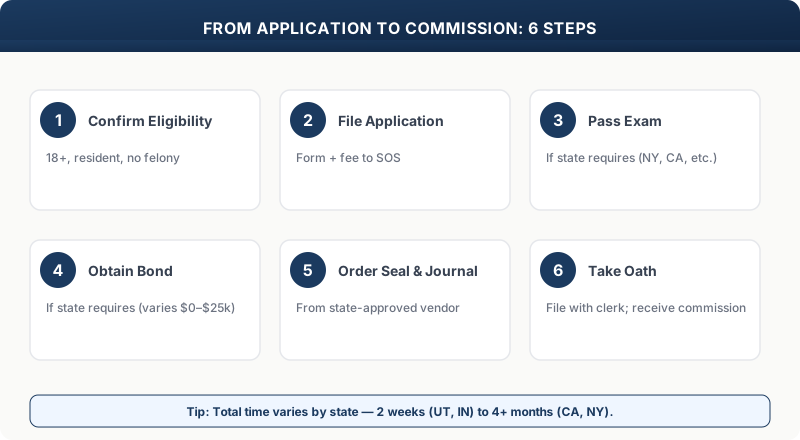
The path from eligibility to active notary commission follows a predictable sequence in most states. Here is the standard seven-step process.
Step 1: Confirm Eligibility
Review your state's specific eligibility requirements, available from the Secretary of State's website (or equivalent commissioning authority). Confirm your residency status, check for any disqualifying record, and verify that you meet the age requirement. This step takes 15 minutes and prevents wasted application fees later.
Step 2: Complete Required Education
Not all states require pre-commission education, but the number that do is growing. As of 2026, the following require a state-approved notary education course before you can apply: California (6 hours), New York (varies by county), Florida (requires a 3-hour online course), and Colorado (requires a notary education course approved by the Secretary of State). Even in states where education is optional, completing a course is strongly recommended — it significantly reduces the risk of a rejected application or, worse, an improperly executed notarization in the field.
Step 3: Pass the Notary Exam (Where Required)
Several states require a written examination as part of the commissioning process. California and New York are the two most prominent. California's exam is administered by the Secretary of State, covers state notary law and procedures, and must be passed with a score of 70% or better. New York's exam is required for initial applicants and covers similar ground. Florida eliminated its exam requirement years ago; most other states have never required one. If your state requires an exam, study the official notary handbook and take any practice tests your state offers.
Step 4: Submit the Application
Once education and exam requirements are satisfied, submit your formal application to your state's commissioning authority — usually the Secretary of State's office, though in some states it is processed at the county level (New York routes commissions through county clerks). Applications are increasingly available online. You will typically need to provide:
- Full legal name and contact information
- Proof of residency (driver's license or utility bill)
- Criminal background disclosure
- Application fee (typically $10–$120 depending on state)
Some states run a background check as part of the application review. Processing times range from a few days (most states with online applications) to 8–12 weeks (California, which operates on a review cycle).
Step 5: Obtain a Notary Bond
The majority of states require a surety bond before or at the time of commissioning. A surety bond protects the public — not you — from financial harm caused by your notarial misconduct or errors. Bond amounts commonly range from $500 to $15,000. For example:
- California: $15,000 bond
- Florida: $7,500 bond
- Texas: no state bond required (though optional)
- New York: no bond required at the state level (counties may vary)
Bonds are inexpensive relative to their face value — a $15,000 bond in California typically costs around $40 for a four-year term. Bond providers are widely available online and through professional associations such as the National Notary Association (NNA).
Step 6: Take Your Oath of Office
After approval of your application, most states require you to take an official oath of office before your commission becomes active. This is typically a short, formal ceremony administered by a county clerk, court official, or other authorized officer. In some states, the oath is administered by mail or can be self-administered and notarized. Failure to complete the oath within the required window — usually 30 to 90 days of commission issuance — will void your commission and require you to restart the process.
Step 7: Obtain Your Notary Seal and Journal
Once commissioned, you are authorized to obtain your official notary seal (or stamp). Your seal must meet state-specified dimensions, include specific language (your name, commission number, county, and expiration date), and in most states be an embosser or ink stamp — not a digital image, unless you are commissioned for Remote Online Notarization (RON).
A notary journal (also called a record book or notarial register) is required in approximately half of U.S. states and strongly recommended in all others. Your journal is your legal record of every notarization you perform. Maintain it carefully.
State-by-State Notary Requirements at a Glance
The table below covers ten of the most populous states and summarizes key commissioning requirements. Requirements change; always verify with your state's official commissioning authority before applying.
Notes: Bond amounts shown are minimums where required. Fees shown are state application fees and may not include county filing fees, bond premiums, or seal costs. RON availability reflects legislative authorization as of early 2026; operational platforms and specific platform approvals vary by state.
States with the Easiest and Most Rigorous Requirements
Easiest states to get commissioned. Georgia, Michigan, Maine, and Wisconsin are consistently cited as the most accessible states for new notaries. These states have no exam, no mandatory education, low or no bond requirements, and straightforward online applications. Georgia charges a $10 application fee and processes applications quickly. Michigan offers a seven-year commission term — the longest in the country — reducing the frequency of renewal.
Most rigorous states. California has the most demanding initial requirements: a mandatory 6-hour education course, a written state exam (pass rate hovers around 70%), a $15,000 surety bond, a lengthy application review period, and strict ongoing compliance obligations. New York requires applicants to pass a state exam and file with their county clerk, adding a layer of bureaucracy absent in most other states. Colorado and Florida both require education courses and have additional regulatory requirements for notaries who also operate as loan signing agents.
What rigor means in practice. More demanding requirements generally correlate with stronger professional standards and fewer disciplinary actions per capita. If you practice in California or New York, the investment in education pays dividends in your ability to handle complex notarial situations correctly.
What Happens After You're Commissioned
Receiving your commission is the beginning of your professional obligations, not the end of a process.
Maintain your journal. Record every notarization promptly. In states where it is required, an incomplete journal can result in disciplinary action. In all states, a thorough journal is your primary defense if a notarization is ever challenged.
Renew before expiration. Commission terms range from 4 to 7 years depending on your state. Most states require you to reapply (and in some cases re-examine) rather than simply renew. Set a calendar reminder at least 90 days before your expiration date to avoid a lapse in commission.
Stay current on state law. Notary statutes change. Fee caps are adjusted. New notarial acts (like electronic notarization and RON) are added to state law. New technology platforms are approved. Staying current is not optional — performing a notarization under outdated procedures exposes you and your clients to risk.
Consider E&O insurance. Errors and omissions (E&O) insurance is not required in most states but is widely recommended. A policy with $25,000 to $100,000 in coverage can be purchased for under $100 per year and protects you if a clerical error on your part causes financial harm to a signer.
Build your practice. Many notaries start as general-purpose commissioners and grow into specialized work: loan signings, immigration form certifications, estate planning documents, or I-9 employment verification. The National Notary Association and your state's Secretary of State website are the two best starting points for continuing professional development.
Frequently Asked Questions
How long does it take to become a notary?
The timeline varies significantly by state. In Georgia or Michigan, you can be commissioned within two to three weeks of submitting your application. In California, the process — including scheduling the exam, completing education, waiting for application review, and taking your oath — typically takes two to four months. Budget at least 30 days in any state; budget 90 days in California.
How much does it cost to become a notary?
All-in costs range from under $50 in low-barrier states (Georgia, Illinois) to $200–$400 in states with exam fees, mandatory education, and bond requirements. California is the most expensive: education ($50–$100), exam fee ($40), application fee ($40), bond ($30–$50), and seal/journal ($50–$80) add up to roughly $200–$300 before you perform a single notarization.
Can I become a notary in multiple states?
Yes, in most cases. Each state issues its own commission, and you must meet each state's individual requirements. Many professionals who work across state lines hold commissions in two or three states simultaneously. Note that your authority as a notary is geographically limited: a California-commissioned notary can only perform notarizations in California, even if they physically travel to another state to do so.
Do notary commissions transfer when I move to a new state?
No. A notary commission is state-specific and does not transfer. If you move from Texas to Florida, your Texas commission is no longer valid for notarizations performed after your change of residency (in most states). You must apply for a new commission in your new state. Some states require you to formally resign your commission when you leave; others allow it to expire naturally.