Notary Signing Agent Certification (2026)
Founder
Notary Signing Agent Certification: NNA vs LSS vs Others
Becoming a Notary Signing Agent (NSA) isn't just about holding a notary commission. The loan signing industry has developed its own professional credentialing layer — certification programs that signal to title companies, escrow officers, and signing services that you understand mortgage documents, can run a closing competently, and have cleared a background check.
Choosing the right certification matters. It affects which signing services will accept you, how title companies perceive your application, and whether you have the knowledge base to do the job well. This guide compares the four major NSA certification programs — NNA, Loan Signing System, Notary2Pro, and Sign & Thrive — on cost, format, industry recognition, and practical usefulness, so you can make an informed decision rather than a default one.
If you’re just starting out, see How to Become a Notary Signing Agent for the full step-by-step path. This guide focuses on choosing the right certification once you’ve started down that path.
Why NSA Certification Matters
The mortgage closing process involves a stack of documents that can run 100–200 pages. The signer — usually a borrower at the table — needs to understand what they're signing without receiving legal advice. The signing agent's job is to facilitate the process: present each document, explain what it is (not what it means legally), obtain the correct signatures and initials, identify notarizable documents, perform the notarial acts correctly, and return a complete, accurate package.
That's a specific skill set. It requires familiarity with loan document types, closing procedures, and notarial requirements — and it requires the ability to manage signers who are stressed, confused, or pressed for time.
Title Companies Require It
Most title companies won't assign closings to uncertified signing agents. Their lender clients require it as a condition of the closing instructions, and their E&O coverage for closing-related errors is structured around using certified agents. The certification is a threshold requirement, not a differentiator — you need one to be in the game.
E&O Insurance Is Tied to Certification
Errors and Omissions insurance for signing agents is available in higher limits and at better rates when tied to a recognized certification. Some policies are only available to NNA-certified agents. NSA-specific E&O (as opposed to general notary E&O) is what title companies want to see, and the major providers underwrite it around certification status.
It Establishes a Professional Baseline
Beyond gatekeeping, certification programs establish a common baseline of knowledge. Every certified NSA has been tested on loan document identification, closing procedures, and notarial requirements. That baseline reduces variability — a title company in Texas assigning a closing to a certified NSA in California can reasonably assume a floor of competence.
The Four Major NSA Certification Programs
National Notary Association (NNA)
The NNA is the oldest and most widely recognized notary professional association in the United States. Its NSA certification is the closest thing to an industry standard — when title companies and lenders specify "certified signing agent," they frequently mean NNA-certified, even if they don't say so explicitly.
The NNA certification process involves a background screening (required annually for renewal), a proctored online exam covering loan documents, notarial procedures, and signing agent conduct, and E&O insurance — which the NNA also sells directly to its members. The background check is conducted by the NNA through its own screening service and is a key reason title companies trust the credential: it's not self-reported.
The exam covers a specific body of knowledge: identifying and explaining the purpose of common loan documents (Note, Deed of Trust, HUD-1, Closing Disclosure, Right of Rescission), handling common field situations, and understanding the boundaries of the signing agent role. The pass mark is not published, but the exam is considered moderately rigorous — not something to walk into cold.
Annual renewal keeps the credential current and the background check fresh, which matters to lenders and signing services that require ongoing verification rather than a one-time credentialing event.
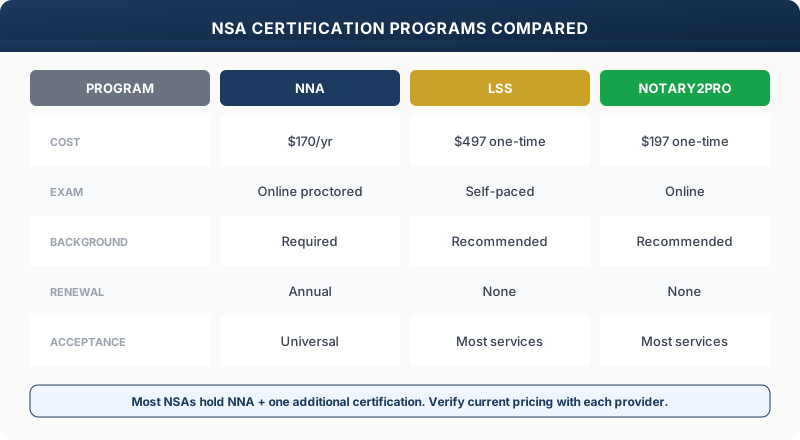
Cost (approximate): $65–$90 for the exam; $65–$85 for the background check; optional E&O insurance at varying rates. Total first-year cost typically $150–$250 depending on insurance selection.
Loan Signing System (LSS)
Loan Signing System was founded by Mark Wills and has grown into one of the most recognized training and certification programs specifically oriented toward building a signing agent business. Where the NNA focuses primarily on credentialing, LSS is explicitly a business-building program — its training covers not just how to perform signings but how to market to title companies, set your fee schedule, and grow your client base.
The LSS certification has two tiers: a standard certification and an advanced certification. The standard program covers loan document training, signing procedures, and a certification exam. The advanced program adds business development content, marketing scripts, and direct title company outreach strategies. LSS includes a loan document training component that many candidates find more comprehensive than the NNA's exam prep — it goes deeper into the "why" of each document rather than just the identification and explanation of each.
LSS has built enough recognition in the signing services market that most major platforms accept the LSS certification alongside NNA. However, for title companies operating with lender-specific requirements, NNA certification may still be specifically required. Some signing agents hold both.
The LSS community — forums, live Q&As, updated training content — is a notable ongoing benefit. The program is more than a test; it's positioned as a career accelerator.
Cost (approximate): $197 for the standard certification; $597 for the advanced program. No separate background check included — candidates must arrange their own screening.
Notary2Pro
Notary2Pro is a training and certification program with a stronger emphasis on document-level education than either NNA or LSS. Its curriculum is built around thorough explanation of every document in a standard loan package — purpose, what the signer is agreeing to, common signer questions, and how to handle complications without crossing into legal advice.
Notary2Pro's program is often cited by experienced signing agents as the most educationally rigorous of the major certifications. Its graduated approach — introduction to loan documents, then hands-on walkthroughs, then assessment — produces candidates who understand the documents they're presenting, not just their names.
Signing service acceptance for Notary2Pro certification is good but not universal. It's widely recognized on platforms like Snapdocs and NotaryCafe, though some assignment sources that require NNA certification specifically won't accept it as a direct substitute. Like LSS, some signing agents pursue Notary2Pro training in addition to NNA certification rather than instead of it.
Notary2Pro also places emphasis on professional presentation and conduct — how to dress, how to set up a signing table, how to handle difficult signers. These soft skills have real field value and aren't covered in depth by every program.
Cost (approximate): $197 for the standard certification course. Background check not included.
Sign & Thrive
Sign & Thrive is Bill Soroka's certification and business development program, positioned similarly to LSS in its dual focus on technical competency and business growth. The program includes loan document training, a certification component, and an extensive library of business development resources — templates, marketing materials, and guidance on building a sustainable NSA practice.
Sign & Thrive has a strong community component, with active membership forums and regular live training sessions. For signing agents who learn well in a community context and want ongoing access to business development content, the community element has genuine value beyond the initial certification.
Industry recognition for Sign & Thrive certification is growing but remains more limited than NNA, LSS, or Notary2Pro for signing service acceptance. It is best understood as a business development program that includes a certification component, rather than a certification program that includes business development content.
Cost (approximate): $397–$497 for the full program. Background check not included.
Side-by-Side Comparison
Notes on background checks: Title companies and some signing services require a background check independent of certification. If your program doesn't include one, you'll need to obtain one separately — typically through Sterling, Checkr, or a state-approved provider. Factor this cost into your comparison.
Notes on E&O insurance: NNA sells E&O directly to members. For LSS, Notary2Pro, and Sign & Thrive certified agents, E&O is purchased separately — National Notary Association, Hiscox, and a handful of specialty providers cover NSA-specific liability.
Which Certification Is Right for You?
The honest answer depends on where you are in your signing agent career and what you're optimizing for.
Starting Out
If you're building an NSA practice from scratch and need to get on signing service platforms as efficiently as possible, NNA certification is the path of least resistance. It's the credential that's most universally recognized, it includes the background check that title companies require, and it opens the most doors with the least friction. The exam is manageable with adequate preparation — the NNA's own study materials are sufficient.
If you're starting out and want both the credential and a structured business launch, Loan Signing System's advanced program provides more hands-on business development guidance than NNA. Budget permitting, some new signing agents do both: NNA certification for the credential, LSS advanced for the business development framework.
Experienced Notaries Adding Loan Signings
If you already have a notary practice and are adding loan signing as a service line, your priority is credential recognition among the title companies and signing services you'll be working with. NNA certification again provides the broadest acceptance. If your target clients work primarily through Snapdocs or NotaryCafe, Notary2Pro or LSS certification is likely sufficient and may provide better document education.
Budget Considerations
If budget is the primary constraint: NNA's exam-only cost is roughly $65–$90, and the background check is $65–$85. That's around $150–$175 before E&O insurance — the most affordable path to the most recognized credential. LSS and Notary2Pro are in the same range for the credential itself; Sign & Thrive costs more and provides less signing service acceptance for the investment.
How Signing Services Evaluate Certifications
Signing services act as intermediaries between title companies and signing agents. Understanding how they evaluate credentials helps you make the right certification decision for your market.
Snapdocs
Snapdocs is one of the largest digital closing platforms and a major source of assignments for signing agents. Snapdocs accepts NNA, LSS, and Notary2Pro certifications. Its platform allows signing agents to upload credential documents, and title companies using Snapdocs can filter by certification type. In practice, NNA certification is the most commonly requested filter on title company assignment requirements pushed through the platform.
NotaryCafe
NotaryCafe is a signing service and marketplace with a large directory of certified signing agents. It accepts NNA, LSS, and Notary2Pro certifications and has its own background screening option. NotaryCafe's acceptance of multiple certifications means candidates have flexibility, though NNA remains the most commonly specified by companies using the platform.
SigningOrder.com
SigningOrder is a signing service that routes assignments from title companies to NSAs. It primarily requires NNA certification for agents who want to receive title company orders through its platform. This is a useful data point: platforms that are aggregating title company requirements tend to default to NNA because that's what the downstream title company clients specify.
The pattern across signing services is consistent: NNA has the broadest unconditional acceptance; LSS and Notary2Pro are accepted on most major platforms but may not satisfy title company requirements that specify NNA by name; Sign & Thrive has more limited acceptance and is best supplemented with NNA or another certification for signing service work.
Notary Guide Newsletter
New training resources, law updates, and field guides — delivered to signing agents who want to stay sharp.
Subscribe at notaryguide.app — free.
After Certification: Tools That Make You More Effective
Certification gets you in the door. What happens at the table is where your reputation is built — one signing at a time, over hundreds of appointments with borrowers who are tired, stressed, and depending on you to run a clean closing.
The practical skills that separate top-earning signing agents from average ones aren't covered in certification exams. They're developed in the field and supported by the right tools.
State-specific notarial compliance is a constant challenge for mobile signing agents who work across state lines or in states with complex notarial requirements. Certificate wording requirements, journal entry fields, acceptable ID types, and oath administration requirements vary by state and change with legislation. Carrying those requirements in memory works until it doesn't — and a defective notarization at a closing creates problems for the title company, the lender, and your assignment relationship.
Document checklist management — ensuring every signature line and initial block is completed before you leave the table — is a procedural discipline that prevents the dreaded callback. A missed signature or initial discovered after you've left requires a re-sign, which delays funding, costs the title company time, and comes back on you as the signing agent.
Offline access to guidance matters at the table. Hospitals, correctional facilities, rural properties, and basement signing rooms don't always have reliable internet. If your compliance reference depends on a browser, it fails in the conditions where you most need it.
Notary Guide is built for exactly this context: an offline-capable compliance and procedure tool that covers all 50 states with current, jurisdiction-specific guidance, organized around the situations signing agents actually encounter. Not a statute library to search — a field guide designed to be used during a signing.
Start with the Right Credential — Then Build on It
Your NSA certification is a foundation, not a ceiling. The notaries who build sustainable, high-income signing practices treat certification as the beginning of professional development, not the end of it.
Get the credential that opens the most doors (NNA, or NNA plus one other). Build your process. Invest in tools that keep you accurate and current. And focus relentlessly on the reputation for quality that generates repeat assignments from the title companies and signing services who actually have work to give.
Notary Guide is in beta now. If you're a signing agent who wants tools designed for field use — offline, accurate, up to date — join us at notaryguide.app.