10 Common Notary Mistakes and How to Avoid Them
Common Notary Mistakes and How to Avoid Them
Every notarization carries legal weight. A single mistake can invalidate a document, delay a real estate closing, expose you to liability, or even put your commission at risk. The good news is that most notary errors are entirely preventable. They stem from rushing, unfamiliarity with the rules, or simple oversight, not from bad intent.
Here are the most common mistakes notaries make and exactly how to avoid each one.
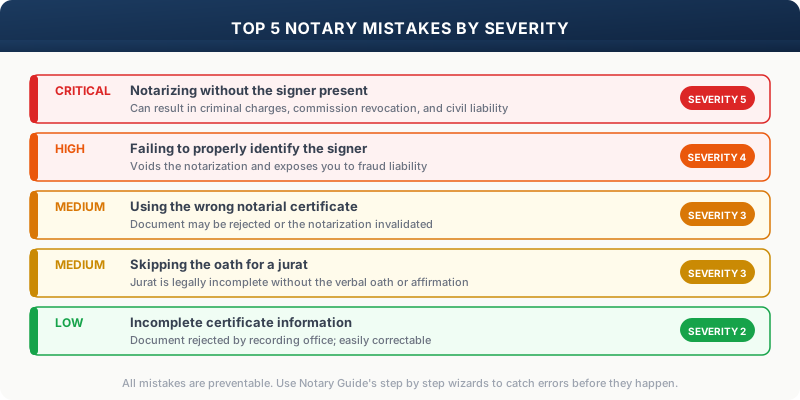
1. Notarizing Without the Signer Physically Present
This is the single most serious error a notary can commit. Every state requires the signer to personally appear before the notary at the time of the notarization (with the exception of approved remote online notarization sessions conducted through authorized platforms).
The temptation usually arises when a signer says they cannot make it to the appointment and asks you to "just stamp it." Sometimes a spouse, colleague, or attorney will present a document already signed by someone who is not present and ask you to notarize it. The answer must always be no.
How to avoid it: Never make exceptions to the personal appearance requirement. If the signer cannot appear, explore whether your state allows remote online notarization as an alternative. Otherwise, the signing must be rescheduled.
2. Failing to Properly Identify the Signer
Skipping or shortcutting identity verification is another high risk mistake. This happens when a notary accepts an expired ID, fails to compare the name on the ID with the name on the document, relies on personal knowledge in a state that no longer allows it, or simply forgets to ask for identification because they are in a rush.
How to avoid it: Treat identification as a non negotiable step. Check the expiration date on every ID. Compare the name, photo, and physical description to the person in front of you. If the name on the ID does not match the name on the document, do not proceed until the discrepancy is resolved. This may require a new document or an AKA statement.
3. Using the Wrong Notarial Certificate
Attaching a jurat certificate when an acknowledgment is required, or vice versa, is surprisingly common. This typically happens when the notary is unfamiliar with the difference between the two acts or when the document does not clearly indicate which type of certificate is needed.
How to avoid it: Read the existing certificate language carefully before completing it. If the certificate says "subscribed and sworn to before me," that is a jurat. If it says "acknowledged before me," that is an acknowledgment. If the document has no certificate, ask the document's originator which act is required and never guess.
4. Incomplete Certificate Information
Recording offices regularly reject documents because the notarial certificate is missing information. Common omissions include the date of notarization, the county and state where the notarization occurred, the notary's commission expiration date, the notary's commission number, or the notary's printed name beneath their signature.
How to avoid it: Before the signer leaves, review every field of the certificate. Make it a habit to scan for blank spaces. Some notaries use a mental checklist: date, venue (state and county), signer name, notary signature, notary printed name, commission number, commission expiration, and seal.
5. Not Administering the Oath for a Jurat
A jurat requires the notary to administer a verbal oath or affirmation. This step is legally essential; without it, the jurat is incomplete. Some notaries skip the oath because they feel awkward about it or because they are rushing through the signing.
How to avoid it: Make the oath a natural part of your process. A simple statement works: "Do you solemnly swear (or affirm) that the statements in this document are true and correct to the best of your knowledge?" Wait for the signer to respond "yes" or "I do" before proceeding. The verbal exchange is the oath and it does not need to be elaborate.
6. Backdating or Future Dating Certificates
The date on a notarial certificate must be the date the signer appeared before you. Signers sometimes ask notaries to backdate a certificate to match the date they actually signed the document, or to use a future date for scheduling purposes. Both are violations in every state.
How to avoid it: Always use today's date, which is the date the signer is physically before you. If the signer signed the document on a different date, that is acceptable for an acknowledgment (where the signer is acknowledging a prior signature). But the certificate date must reflect when the notarial act occurred.
7. Having a Financial Interest in the Transaction
Most states prohibit notaries from notarizing documents in which they have a direct financial interest or from which they stand to benefit. This includes notarizing documents for transactions where you are a party, for your own business deals, or for documents that affect your property.
How to avoid it: If you are named in the document or have any financial interest in the transaction, decline and refer the signer to another notary. The appearance of impartiality is just as important as actual impartiality.
8. Notarizing for Family Members
Many states prohibit notaries from performing notarial acts for immediate family members, including spouses, parents, children, and siblings. Even in states that do not explicitly prohibit it, notarizing for close relatives creates a conflict of interest that could be challenged in court.
How to avoid it: Check your state's rules on notarizing for family members. Even if your state allows it, it is best practice to avoid it when another notary is reasonably available. The potential for conflict of interest is not worth the convenience.
9. Providing Legal Advice
Signers frequently ask notaries questions that cross into legal territory: "Is this a good deal?" "Should I sign this?" "What does this clause mean?" Answering these questions constitutes the unauthorized practice of law, regardless of how knowledgeable you may be.
How to avoid it: Understand the boundary clearly. You can explain the notarial process (what an acknowledgment is, what a jurat requires). You cannot explain the legal effect of the document or advise the signer on whether to sign. If a signer has questions about the document's content, direct them to an attorney or the document's originator.
10. Failing to Keep a Journal
In states that require journals, failing to maintain one is a direct violation. In states where journals are optional, not keeping one leaves you without any evidence of your notarial acts, which becomes a serious problem if a notarization is challenged.
How to avoid it: Keep a journal for every notarization, regardless of whether your state requires it. Make your entry at the time of the notarization, not later. Include all required information plus the signer's signature and identification details.
How Notary Guide Helps
Most of these mistakes happen because of the cognitive load of remembering different rules, procedures, and requirements, especially under time pressure. Notary Guide's step by step compliance wizards walk you through every notarial act in your commissioned state, prompting you for each required step and flagging potential issues before they become mistakes.
The browser extension works offline, so you have reliable guidance whether you are in an office or at a mobile signing location. It covers all 14 notarial act types across all 50 states, including identity verification requirements, certificate wording, journal obligations, and prohibited acts.
Key Takeaways
The personal appearance requirement is inviolable. Never notarize without the signer present. Always verify identity using your state's approved methods. Read the certificate language to determine whether an acknowledgment or jurat is required. Complete every field of the certificate before the signer leaves. Administer the oath for every jurat. Use today's date on every certificate. Decline notarizations where you have a conflict of interest. Never give legal advice.
Prevent these common errors with state specific guidance from Notary Guide. Try it free during the beta.