Notary Acknowledgments: 50 State Guide (2026)
Complete Guide to Notary Acknowledgments: 50 State Requirements
An acknowledgment is the most common notarial act performed in the United States. Whether you are notarizing a deed, a power of attorney, or a trust document, chances are you will be asked to take an acknowledgment. Getting it right protects the signer, the receiving party, and your commission.
This guide walks through exactly what an acknowledgment is, when it is required, how to perform one correctly, and how requirements differ across all 50 states.
What Is a Notary Acknowledgment?
An acknowledgment is a formal declaration by a signer, made in the presence of a notary public, that they signed a document voluntarily and that the signature on the document is theirs. Unlike a jurat, the signer does not need to sign the document in front of you. They only need to appear before you and acknowledge that the signature already on the document is genuine and was made willingly.
The notary's role in an acknowledgment is threefold: verify the signer's identity, confirm the signer's willingness, and complete the notarial certificate.
When Is an Acknowledgment Required?
Acknowledgments are most frequently required for documents that will be recorded with a county recorder or clerk's office. Common examples include:
Real estate deeds and deeds of trust, powers of attorney, trust certificates and amendments, mortgage documents, corporate resolutions and articles of incorporation, and certain affidavits depending on the state.
If a document does not specify which notarial act is required, look at the certificate language. Acknowledgment certificates typically include phrases such as "personally appeared before me and acknowledged" rather than "subscribed and sworn to before me," which indicates a jurat.
How to Perform an Acknowledgment
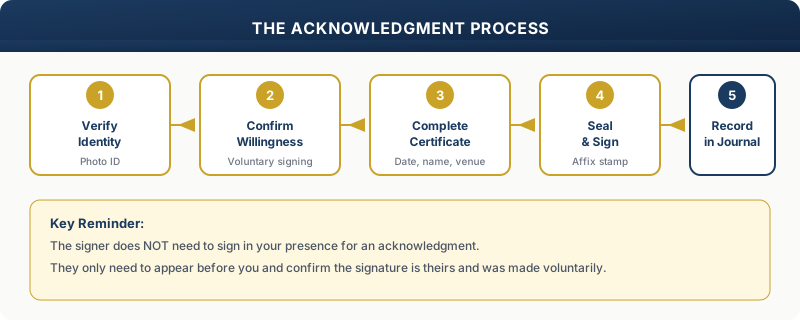
Step 1: Verify the signer's identity. Every state requires you to positively identify the document signer. Most states accept current government issued photo identification such as a driver's license, passport, or state ID card. Some states also allow identification through credible identifying witnesses or personal knowledge, though the rules vary significantly.
Step 2: Confirm the signer's awareness and willingness. Ask the signer whether they understand the document they have signed and whether they signed it voluntarily. You are not required to read or understand the document yourself, but you must be satisfied that the signer is acting of their own free will and is not under duress.
Step 3: Complete the notarial certificate. Fill in the certificate with the date, the signer's name, your name, your commission details, and your notarial seal or stamp. The certificate wording varies by state; many states have statutory certificate language that must be used verbatim.
Step 4: Affix your seal and sign. Apply your official notary seal or stamp to the certificate and sign your name exactly as it appears on your commission. Some states require the seal to be within a certain distance of your signature.
Step 5: Record the transaction in your journal. Many states require notaries to keep a journal of all notarial acts performed. Even in states where a journal is not legally required, keeping one is considered a best practice and provides legal protection.
Signer Identification Requirements
Identification rules vary meaningfully from state to state. Here is what you need to know about the most common approaches.
Government issued photo ID is accepted in all 50 states. A current, unexpired driver's license, passport, or state issued identification card will satisfy identification requirements everywhere. Some states specify additional acceptable forms of ID such as military identification or foreign passports.
Credible identifying witnesses are allowed in many states as an alternative to photo ID. In this scenario, one or two individuals who personally know the signer vouch for the signer's identity to the notary. California, for example, requires two credible witnesses if the notary does not personally know the signer and the signer lacks acceptable ID. Other states allow a single credible witness.
Personal knowledge of the signer is accepted in some states but is increasingly discouraged or restricted. States like Florida and Texas have eliminated personal knowledge as a standalone method of identification for most notarial acts.
Certificate Wording Across States
Most states provide statutory acknowledgment certificate language that notaries must use. While the wording differs, acknowledgment certificates generally include: the state and county where the notarization takes place, the date of the notarization, the name of the signer, a statement that the signer appeared before the notary and acknowledged the document, the notary's signature, printed name, commission number, and commission expiration date, and the notary's seal or stamp.
Some states, including California and Florida, have very specific statutory wording that must not be altered. Other states are more flexible, allowing notaries to use "substantially similar" language. When in doubt, use your state's statutory language exactly as written.
Common Acknowledgment Mistakes
Notarizing without the signer present. The signer must physically appear before you, even though they do not need to sign the document in your presence. Performing an acknowledgment over the phone or based on a mailed document is illegal in all states for traditional notarizations.
Failing to verify identity properly. Accepting an expired ID, failing to compare the name on the ID to the name on the document, or skipping identification entirely can expose you to liability and may void the notarization.
Using the wrong certificate type. Attaching a jurat certificate when an acknowledgment is required, or vice versa, is a surprisingly common error. Always read the document's instructions carefully.
Incomplete certificate information. Leaving blank fields in the certificate, such as the date, county, or your commission expiration, can cause the document to be rejected by a recording office.
Backdating or future dating the certificate. The date on the certificate must be the date the signer appeared before you. Altering the date to match a different day is a violation in every state.
How Notary Guide Helps
Keeping track of acknowledgment rules across multiple states is challenging, especially for mobile notaries and signing agents who work across state lines. Notary Guide provides step by step compliance instructions for acknowledgments in all 50 states, including state specific certificate wording, accepted identification types, journal requirements, fee caps, and prohibited acts.
The browser extension walks you through each step of the acknowledgment process for your commissioned state, flagging requirements and warnings in real time. It works offline, so you have reliable guidance even when you are in the field without an internet connection.
Key Takeaways
An acknowledgment confirms the signer's identity and willingness. They do not need to sign in your presence. Always verify identity using your state's approved methods. Use your state's statutory certificate wording when available. Record every acknowledgment in your notary journal. Stay current with your state's requirements, as notary laws are updated regularly.
For step by step acknowledgment guides tailored to your specific state, try Notary Guide free during the beta period.