Notary Fees by State: Complete 2026 Guide

Notary Fees by State: Complete 2026 Guide
Every state sets maximum fees that notaries can charge for their services. These caps vary dramatically, from as low as $2 per notarization in some states to $25 or more in others. Charging more than your state allows is a violation that can result in fines, commission revocation, or civil liability.
This guide breaks down how notary fees work, what you can and cannot charge for, and provides an overview of fee structures across the states.
How Notary Fee Caps Work
State notary fee laws set the maximum amount a notary may charge for performing a notarial act. These are caps, not fixed rates. You can always charge less than the maximum, and you can waive your fee entirely. But you may never charge more.
Fee caps typically apply per notarial act or per signature, depending on the state. This distinction matters. If a document has three signatures that each require notarization, a per signature fee applies to each one individually. A per act fee may apply to the entire notarization session or to each distinct notarial act performed.
Some states set a single fee cap for all notarial acts, while others establish different maximums for different types of acts. Jurats, acknowledgments, oaths, and other acts may each have their own fee cap.
Fee Ranges Across the States
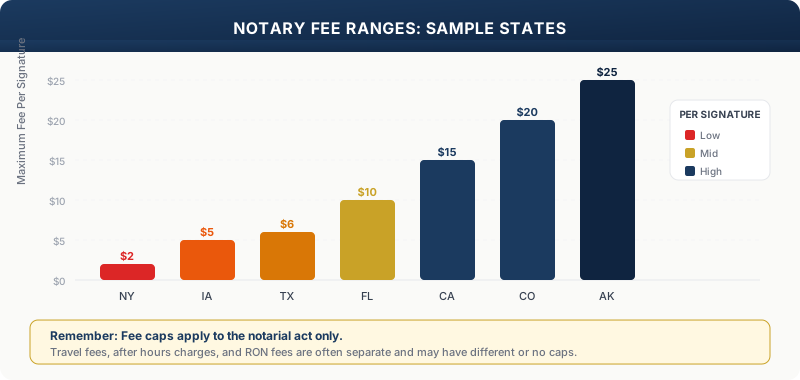
Notary fee caps span a wide range. At the lower end, states like Iowa, Kansas, and Nebraska set maximum fees at $5 or less per act. In the middle range, states like California ($15 per signature), Texas ($6 per signature for most acts), and New York ($2 per signature) represent common fee structures. At the higher end, states like Alaska, Colorado, and Montana allow $10 to $25 or more per notarization.
These caps are for the notarial act itself. They do not include travel fees, after hours fees, or other charges that some states allow notaries to collect separately.
Travel Fees and Convenience Charges
Many states allow mobile notaries to charge travel fees on top of the per signature notary fee. This is separate from the notarization itself and compensates the notary for travel time and vehicle expenses.
State rules on travel fees fall into three general categories. Some states set a specific travel fee cap or formula, such as a maximum per mile reimbursement. Other states allow reasonable travel fees but do not specify a maximum, leaving it to the notary to set a fair rate. And some states are silent on travel fees, which generally means there is no specific prohibition but also no explicit authorization.
When charging travel fees, it is best practice to disclose the fee upfront before the appointment and to keep it reasonable and documented. Some notaries charge a flat fee based on distance, while others use a per mile rate.
After Hours and Weekend Fees
Some states permit notaries to charge additional fees for appointments outside of regular business hours or on weekends and holidays. Like travel fees, these must be disclosed in advance and should be reasonable.
Not all states address after hours fees in their statutes. If your state is silent on the issue, consult your commissioning authority for guidance before adding premium charges to your fee schedule.
RON and Electronic Notarization Fees
Remote online notarization (RON) often carries a separate, typically higher, fee cap than traditional in person notarization. This reflects the additional technology costs, identity verification procedures, and recording obligations involved in RON.
States that authorize RON usually specify either a separate RON fee maximum or clarify that the standard fee cap applies. Some states also allow the technology platform to charge a separate fee, which is distinct from the notary's own fee.
If you perform RON, make sure you understand both your state's fee cap for RON notarizations and any fees the platform charges to the signer. The total cost to the signer should be transparent.
What You Cannot Charge For
There are several things notaries may not charge for. You cannot charge for administering an oath or affirmation when it is part of a jurat (the oath is included in the jurat fee). You generally cannot charge for travel to a signing if you did not disclose the travel fee in advance. You cannot charge for notarial acts you did not perform. And in some states, you cannot charge for certifying copies of your own journal entries when requested by the signer or an authorized party.
You also cannot charge a "document preparation" fee or a "service fee" that is disguised as something other than the notarial fee. If you prepare documents as part of a separate business (such as a loan signing), those fees must be distinct from your notary fees.
How to Set Your Fee Schedule
Within your state's legal limits, you have flexibility to set your fees. Here are some practical considerations.
Research what other notaries and mobile notaries in your area charge. Your fees should be competitive but also reflect the value of your service, your travel costs, and your time. Post your fee schedule on your website or marketing materials so clients know what to expect. Always quote fees before the appointment, as surprising a client with charges after the notarization damages your reputation and may violate state disclosure rules.
Consider offering a simple fee structure. A flat fee per signature plus a travel fee (if applicable) is easy for clients to understand and avoids disputes.
How Notary Guide Helps
Notary Guide includes state specific fee data as part of its compliance information for all 50 states. When you select your commissioned state, you can instantly see the maximum fee per signature for traditional notarizations, the maximum fee for RON (if applicable), whether travel fees are allowed and any caps that apply, and any special fee rules for specific document types.
This information is built into the step by step guides, so you have the fee data at hand during every notarization session. The data is sourced from state statutes and updates when laws change.
Key Takeaways
Every state sets maximum notary fees, so never exceed your state's cap. Fees may be set per signature, per act, or per session depending on the state. Travel fees are separate from notary fees and are governed by different rules. RON fees are often higher than traditional notarization fees. Always disclose all fees to the client before the appointment. Keep your fee schedule simple, competitive, and transparent.
Look up your state's specific fee caps and rules using Notary Guide, available free during the beta.