Notary Journal Requirements by State (2026)

Notary Journal Requirements by State: Complete 2026 Guide
A notary journal is your single most important record keeping tool. It creates a contemporaneous record of every notarization you perform, providing legal protection for you, your signers, and the public. Whether your state requires one or not, maintaining a detailed journal is widely considered the gold standard of notary practice.
This guide covers which states require journals, what information must be recorded, acceptable journal formats, and how long you need to retain your records.
Why Keep a Notary Journal?
Even in states where a journal is not legally mandated, keeping one protects you in several important ways.
A journal provides evidence of what happened during a notarization if the transaction is later challenged in court. It demonstrates that you followed proper procedures, verified identity, and performed the notarial act correctly. Without a journal, you have no contemporaneous documentation to support your actions, which can leave you vulnerable to liability claims.
A journal also helps detect potential fraud. If someone attempts to forge your notarial certificate, your journal will show whether you actually performed a notarization for that individual on the date in question. This kind of evidence is invaluable in fraud investigations.
States That Require a Notary Journal
As of 2026, the following states mandate that notaries keep a journal or record book of their notarial acts: Arizona, California, Colorado, Hawaii, Illinois, Iowa, Maryland, Massachusetts, Minnesota, Mississippi, Missouri, Montana, Nevada, New York (for electronic notarizations), North Carolina, Oregon, Pennsylvania, Tennessee, Texas, Utah, Virginia, Washington, and the District of Columbia.
The remaining states either strongly recommend journals or are silent on the requirement. However, the trend is clearly toward mandatory journal keeping, with several states adding requirements in recent years.
What Must Be Recorded?
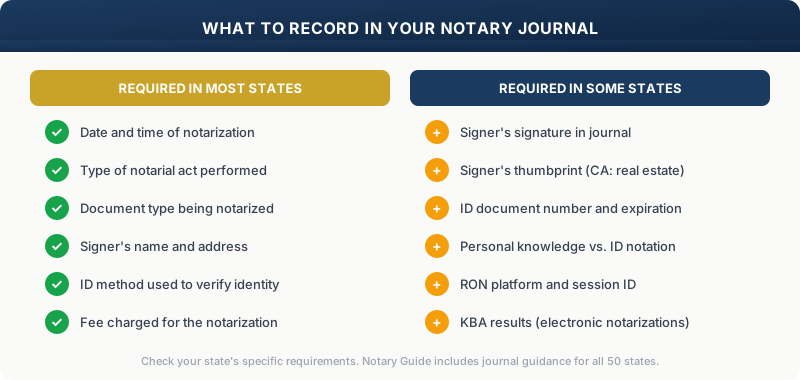
The specific entries required vary by state, but most states that mandate journals require the following information for each notarization: the date and time of the notarization, the type of notarial act performed (acknowledgment, jurat, oath, etc.), the type of document being notarized, the name and address of the signer, the method used to identify the signer, the signer's signature (in some states), and the fee charged.
Some states require additional information. California, for example, mandates that notaries record a thumbprint of the signer for certain real estate documents. Virginia requires the notary to record whether the signer was personally known or identified through satisfactory evidence.
Journal Format: Paper vs Electronic
States vary on whether they accept electronic journals, paper journals, or both.
Paper only states still exist and generally require a bound journal with sequentially numbered pages. Loose leaf journals or binders are not acceptable because pages can be removed or rearranged. The journal should have a tamper evident binding so that any attempt to remove or alter pages is visible.
Electronic journal states allow notaries to maintain their records in an electronic format, provided the journal meets certain security requirements. These typically include password protection, backup procedures, and tamper evident technology that prevents unauthorized modification.
Dual format states allow either paper or electronic journals at the notary's discretion. If you choose to go electronic, make sure the software you use meets your state's specific requirements.
Journal Retention Periods
How long you must keep your journal after completing it or after your commission expires also varies by state. Common retention periods range from five years to ten years after the last entry, though some states require permanent retention or have no specified time limit.
California requires notaries to keep their journals and deliver them to the county clerk upon resignation, revocation, or expiration of their commission. Arizona requires retention for the life of the notary. Texas requires that journals be maintained for the duration of the commission.
When your retention period ends, do not simply throw your journal away. Many states have specific procedures for disposing of or surrendering journal records.
Electronic Notarization Journal Requirements
With the growth of remote online notarization, many states have added specific journal requirements for electronic and RON transactions. These often include additional data points such as the technology platform used, the audio visual recording storage location, and the knowledge based authentication results.
If you perform both traditional in person notarizations and electronic notarizations, check whether your state requires separate journals for each type or allows combined record keeping.
Best Practices for Journal Keeping
Make entries at the time of notarization. Do not wait until the end of the day or the next morning to record your journal entries. Contemporaneous entries are far more credible if challenged in court.
Never leave blank lines between entries. Blank spaces could allow someone to insert a fraudulent entry. Draw a line through any unused space.
Use ink, not pencil. Journal entries should be permanent and resistant to alteration.
Keep your journal secure. Your journal contains personal information about your signers. Store it in a locked location when not in use, and never leave it unattended at a signing location.
Start a new journal before the old one is full if your commission is about to expire. This makes it easier to manage retention periods and surrender requirements.
How Notary Guide Helps
Notary Guide includes state specific journal requirements as part of every compliance guide. When you perform a notarial act using the browser extension, it reminds you what information must be recorded in your journal based on your commissioned state's laws. This is especially valuable for notaries commissioned in multiple states or for mobile notaries who travel across state lines.
The extension covers whether your state requires a journal, what format is acceptable, what information must be recorded per entry, the retention period for your state, and any special rules for electronic or RON journals.
Key Takeaways
Most states now require a notary journal, and the trend is toward universal adoption. Even if your state does not require one, keeping a journal is the strongest protection you have against liability claims. Record entries at the time of the notarization, use permanent ink, and secure your journal at all times. Know your state's retention requirements and follow proper disposal procedures.
Check your state's specific journal requirements using Notary Guide, available free during the beta.