Remote Online Notarization (RON): State Guide 2026
Remote Online Notarization (RON): State by State Guide
Remote online notarization, commonly known as RON, allows a notary public to notarize documents for signers who are not physically present. Instead, the notary and signer connect through a secure audio video communication platform, and the document is signed and notarized electronically.
RON has grown rapidly since 2020, and the legislative landscape continues to evolve. This guide covers which states authorize RON, how it works, what technology is required, and what notaries need to know to get started.
What Is Remote Online Notarization?
In a traditional notarization, the signer must physically appear before the notary. RON removes that geographic requirement. The signer and notary connect through a live, two way audio video session. The signer applies an electronic signature to the document, and the notary applies their electronic seal and signature, all within an approved technology platform.
RON should not be confused with remote ink signed notarization (RIN), where the signer appears via video but signs a physical paper document. RON is fully electronic from start to finish.
Which States Allow RON?
The number of states authorizing RON has grown significantly. As of early 2026, the vast majority of U.S. states have enacted some form of RON legislation. The specifics vary, but most RON authorizing states share a common framework built around identity verification, audio video recording, and approved technology platforms.
States that were early adopters of permanent RON legislation include Virginia (the first state to authorize RON in 2012), Texas, Florida, Ohio, Idaho, Indiana, Kentucky, Maryland, Michigan, Minnesota, Montana, Nebraska, Nevada, North Dakota, Oklahoma, Tennessee, Utah, and Wisconsin.
Many additional states enacted RON laws during and after the pandemic period, and several others have legislation pending. Because this landscape changes frequently, notaries should verify their state's current RON status through their commissioning authority.
RON Requirements for Notaries
To perform remote online notarizations, most states require notaries to meet additional qualifications beyond their standard commission. These commonly include completing a state approved RON training course, registering as a RON authorized notary with your state's commissioning authority, obtaining an electronic seal and electronic signature, and enrolling with an approved RON technology platform.
Some states charge a separate registration fee for RON authorization, and some require additional bonding or insurance beyond what is required for traditional notarizations.
Identity Verification in RON
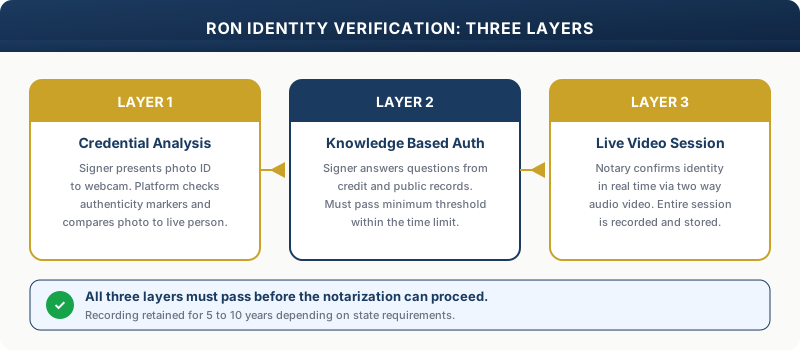
Because the signer is not physically present, RON relies on multi layered identity verification. Most states require at least two forms of identity proofing.
Credential analysis involves the signer presenting a government issued photo ID to their webcam. The RON platform's technology analyzes the ID for authenticity markers, checks for tampering, and compares the photo on the ID to the live person on camera.
Knowledge based authentication (KBA) presents the signer with a series of questions drawn from their credit and public records history. These are questions that only the real person would know the answers to, such as previous addresses, vehicle registrations, or financial account details. The signer must correctly answer a minimum number of questions within a time limit.
Some states are beginning to allow or require additional verification methods such as biometric comparison or dynamic identity proofing.
Technology Platform Requirements
RON must be conducted through a technology platform that meets your state's requirements. These platforms handle the audio video connection, identity verification, electronic signature application, and session recording. Common requirements for RON platforms include secure, encrypted audio video communication, tamper evident recording and storage of the session, electronic signature and seal functionality compliant with state and federal e signature laws, credential analysis and KBA integration, and audit trail generation for every step of the process.
Notaries generally cannot use consumer video conferencing tools like Zoom or FaceTime for RON. The platform must be specifically designed and approved for remote notarization.
Recording and Storage Requirements
Nearly all RON authorizing states require the notary to make an audio video recording of the entire notarization session. This recording serves as the definitive record of what transpired and must be stored securely for a specified retention period.
Retention periods vary by state but commonly range from five to ten years. Some states require the recording to be stored by the technology platform, while others allow the notary to maintain their own copies. The recordings must be kept confidential and are generally only accessible through a court order or an investigation by the commissioning authority.
Fees for RON Notarizations
Many states allow notaries to charge higher fees for RON notarizations than for traditional in person notarizations, reflecting the additional technology and compliance costs involved. Fee caps for RON vary significantly. Some states set specific RON fee maximums, while others defer to the technology platform's pricing structure.
Check your state's fee schedule before performing RON, and make sure you understand whether the fee cap applies per signature, per notarial act, or per session.
Common RON Scenarios
RON is particularly valuable for real estate closings where the signer is located in another state or country, estate planning documents when elderly or mobility impaired signers cannot easily travel, business transactions involving parties in multiple locations, and military personnel and their families stationed overseas or in remote locations.
Many title companies and lenders now accept RON for real estate closings, though acceptance is not universal. Always confirm with the receiving party that they will accept a remotely notarized document before proceeding.
Limitations and Restrictions
Not all documents can be remotely notarized in every state. Common restrictions include self proved wills (prohibited from RON in some states), certain family law documents, documents requiring physical witnesses in addition to notarization, and documents destined for jurisdictions that do not recognize RON.
Additionally, some states restrict RON to documents with a connection to that state. For example, some require that either the notary or the signer be located in the state, or that the document relate to a transaction within the state.
How Notary Guide Helps
RON compliance is complex because the rules sit on top of existing notary law, adding technology requirements, enhanced identity verification procedures, and recording obligations. Notary Guide includes RON specific guidance for every state that authorizes remote online notarization.
The Pro plan includes full RON and eNotarization guides that walk you through the process step by step, including platform requirements, identity verification procedures, recording obligations, and state specific restrictions. The guidance updates as states amend their RON laws, so you always have current information.
Key Takeaways
Most states now authorize some form of remote online notarization. RON requires additional training, registration, and technology beyond a standard notary commission. Identity verification in RON relies on credential analysis, KBA, and live video comparison. All RON sessions must be recorded and stored for the state's required retention period. Not all documents can be notarized via RON, so check your state's restrictions. Confirm with the receiving party that they accept RON documents before proceeding.
Explore RON requirements for your state with Notary Guide. Try it free during the beta.